Praise and Prayers for Pleasure: A Self-Pleasure Series

First, thank you for coming back to explore our praise and worship for pleasure series.
It’s not easy to stay engaged with a subject matter that’s new, uncomfortable, and possibly goes against what you’ve been taught. That takes courage and I applaud that.
In this part of the series, we explore the use of prayers as a pleasure practice. Sounds odd, yes? Of course. If you were raised in one of the many Abrahamic faiths, you were taught, in very subtle ways, that sex and spirituality weren’t intertwined and if you wanted to explore, it had to be under the guise of marriage. One could pray for a pleasure-filled and fruitful marriage, but the operative word here is marriage, not relationship, interactions, engagements, or experiences.
This is where I come to offer perspective.
But first, we have to review the historical context and I enjoy using movies of Old England as a reference because it is where we’ve gotten our colonial views surrounding spirituality and Christianity.
You could say that our depictions of medieval England are outlandish, but are they?
There’s historical context of same sex and two spirited relationships hidden in the darkest of shadows and on the chopping block of persecution if ever revealed. Empires destroyed and rebirth due to “bastard” children and marriages between distant cousins to maintain blood lines and imperial power.
The monarchy [thank Henry Tudor] has provided queues to how we interact with what is holy, how we display worship and praise, and who “god” calls to lead this charge. I believe the Tarot’s Hierophant is less Pope-like and more patriarch as it pertains to who disseminates information to the masses and maintains the order of religious sanctimony.
Maybe I’ll explore those thoughts one day.
With that context, when we skip ahead to the version of Christianity our parents and grandparents practice, we can see how it is rooted in purity culture, respectability politics, and misogyny. Much of that still lives today in many religious institutions. This creates a roadblock to exploring how spiritual concepts translate into our human experience. How we can dive deeper into the Song of Songs (Solomon)—an entire erotic novel praising a Black woman embedded in the Bible—to better understand the erotic as a medium for spiritual ascension, adoration, and body worship.
“ A bundle of myrrh is my well-beloved unto me; he shall lie all night betwixt my breasts ”
That last part is the challenge.
Thoughts of worshiping the body, especially another human body, feels gratuitous. The conditioning surrounding the linear perspective of praise, prayers, and worship is not easy to reframe but it begins with expanding our view.
During my Catholic school days, the way the nuns spoke about ecstasy implied an air of perfection. Touting that only the most sanctified and holy could achieve such an etheric ascension. In this container, we would assume that priests and other practitioners of the cloth have the ability to meet this zenith of pleasure; however, many of us know from experience this is a farce.
Click here and here for further exploration.
To reframe praise, prayer, and worship in the context of pleasure, we have to look at its original definitions. According to Merriam-Webster, they are as follows:
Praise (v.) to express favorable judgment or commend. To glorify (a saint or god) especially by attributions of perfection.
Prayer (n.) an address (such as a petition) to God or a god in word or thought. To earn a request or wish.
Worship (v.) to honor or show reverence for as a divine being or supernatural power. To regard with great or extravagant respect, honor or devotion.
The challenge with adopting these words to a pleasure practice that places ourselves on a pedestal, positions us as the muse is because we’re made to see ourselves as beneath the higher power we exalt. If we are to move attuned with being made in the image and likeness of a higher power/Source/God and its many names, then wouldn’t our divinity be in equity? Why would this higher power create us to be removed from our own divinity—drones disconnected from our connection to higher consciousness, the Earth, and all the galactic nuances that tether us to this space and time?
To me, it’s nonsensical. So the way we should praise, pray, and worship ourselves is centered around self-preservation, adoration, and acceptance. Seeing ourselves as holy without the need to follow an order or make unnecessary sacrifices to prove we’re worthy to be praised. To help us shift and reframe praise, prayer, and worship, I redefined these terms in the context of pleasure:
Praise (v.) is the verbal expression of adoration, admiration, and affirmation of oneself, someone, or something. Through praise we acknowledge the divinity of ourselves and the collective.
Prayer (n.) is a conversation to and of the Divine that gives reverence, seeks solutions, and sets intentions.
Worship (v.) takes praise a step further by enacting adoration and devotion through physical touch, adornments, and sensory elements that amplify our unique frequencies.
Each of these words center the process of self-love, self-care, and self-pleasure. It puts our needs at the forefront and prioritizes how we wish to experience pleasure and the many ways pleasure can be experienced. Some years ago, I received a download about prayer for pleasure and captured some thoughts I synthesized.
To engage in self-praise is to affirm you are a pleasure-centered being. To pray for pleasure asserts that we desire a more immersive human experience that leads us to joy, nostalgia, arousal, peace, and incitement. Worshiping ourselves indicates our love for self, the excitement to be in this body and have these experiences, the desire to dress ourselves attuned with our natural frequencies, to exalt our divinity and humanity in wholeness, and feel grounded in the seat of our pleasure (EbonyJanice 2022).
We affirm ourselves in the name of capitalism and religious mores, why not do the same in pleasure? The prompts below offer a foundation to begin seeing yourself a pleasure-centered being and acknowledge the part of you that desires a deeper relationship with what this looks like at this time:
I am________________
I deserve_______________
I desire_________________
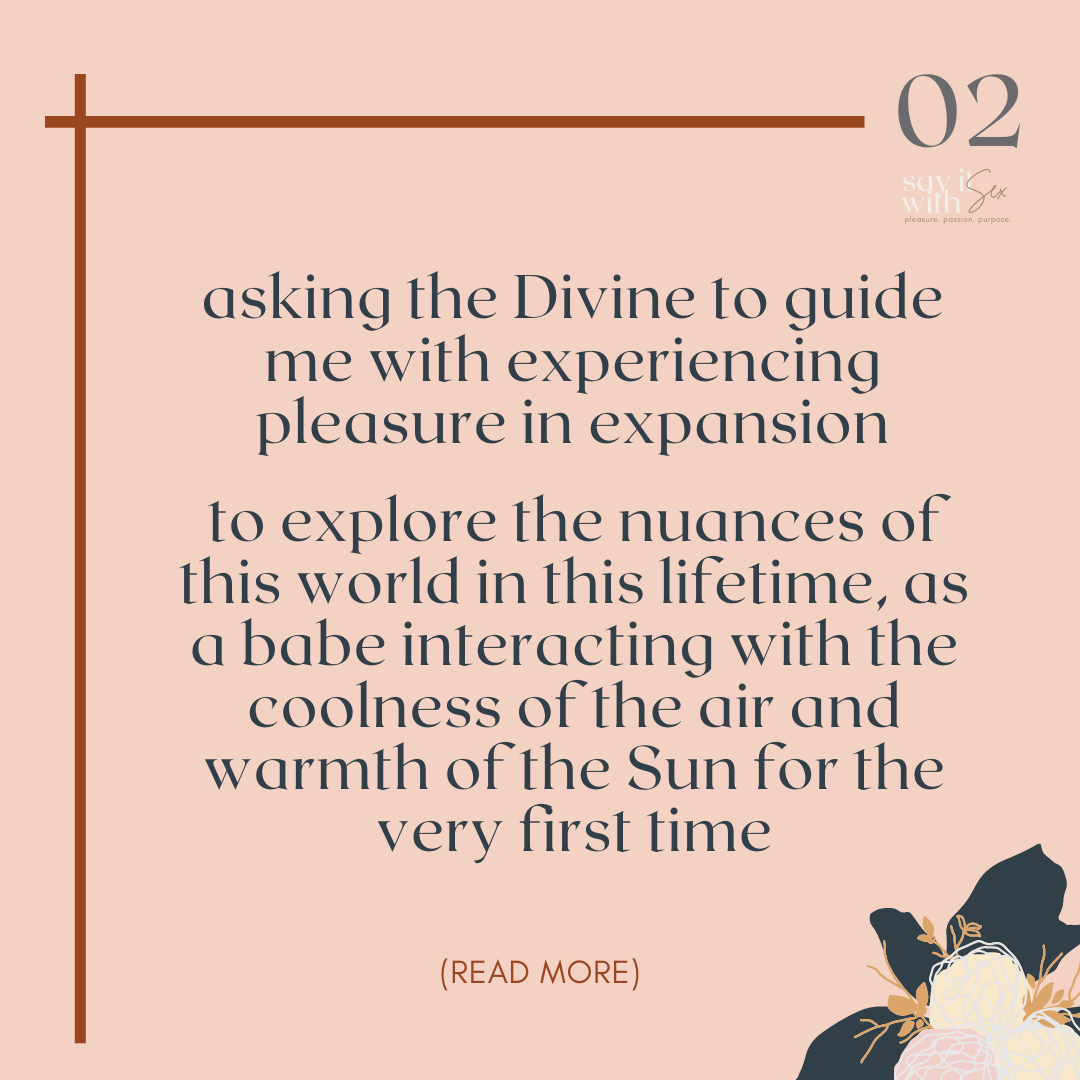
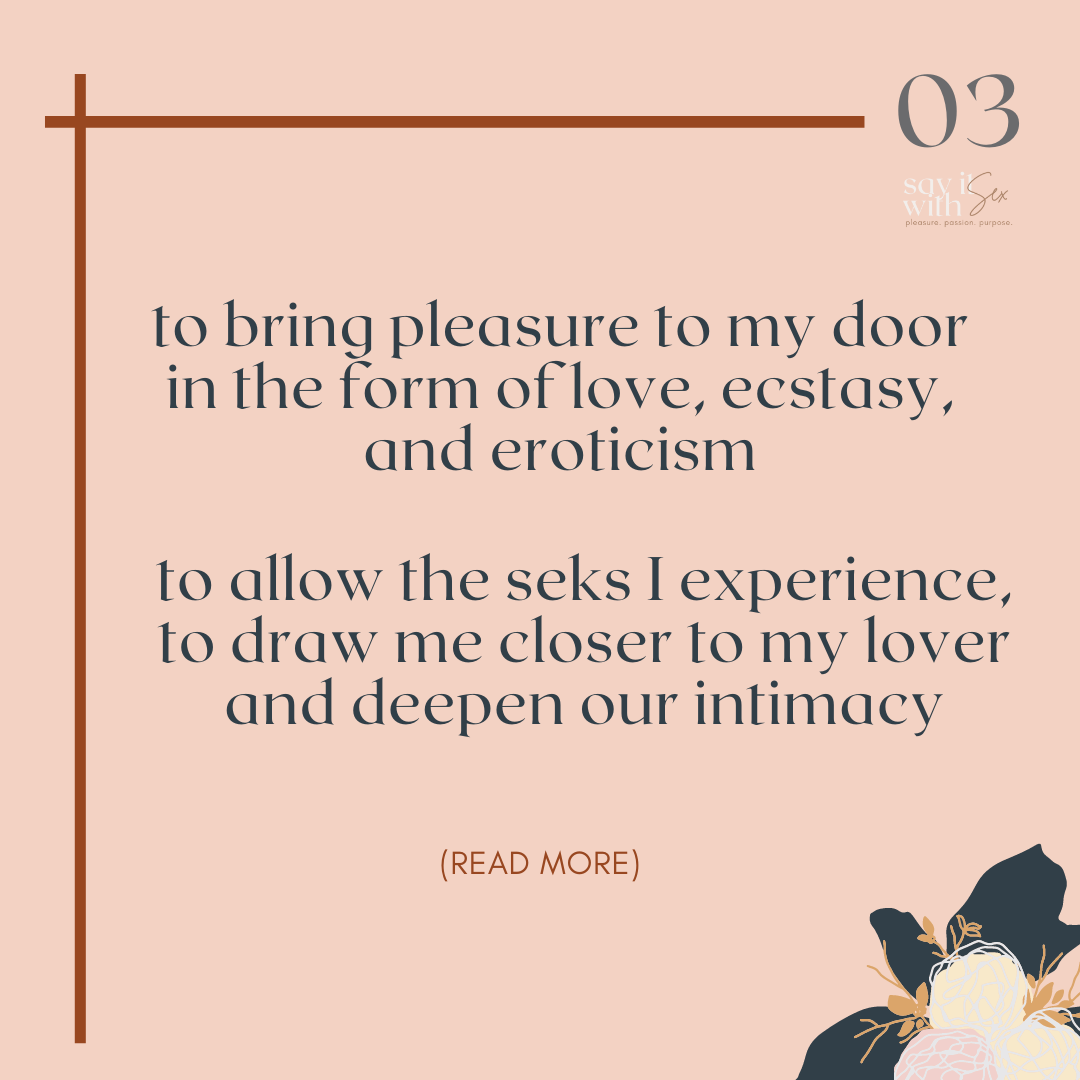
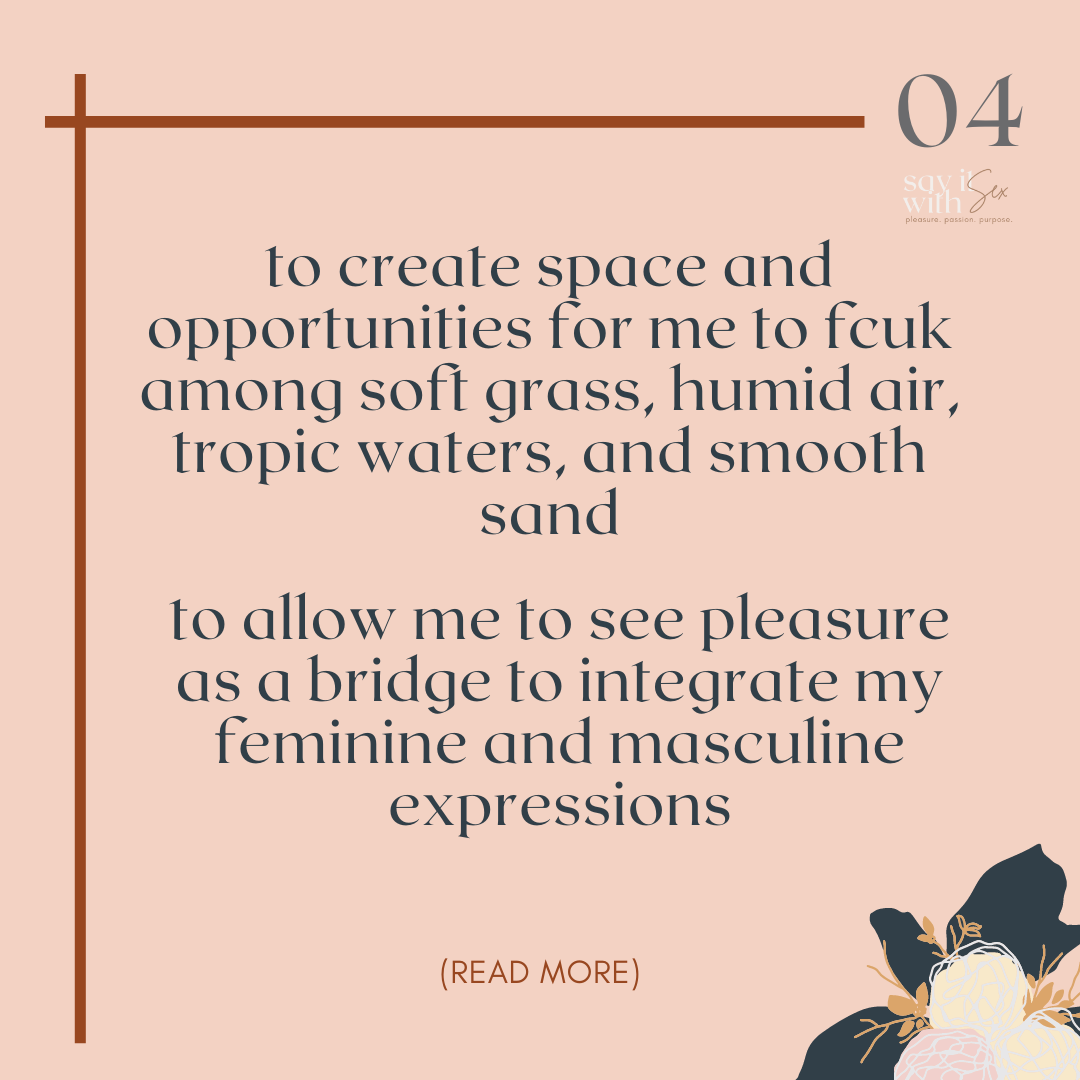
When considering a prayer for pleasure, start here:
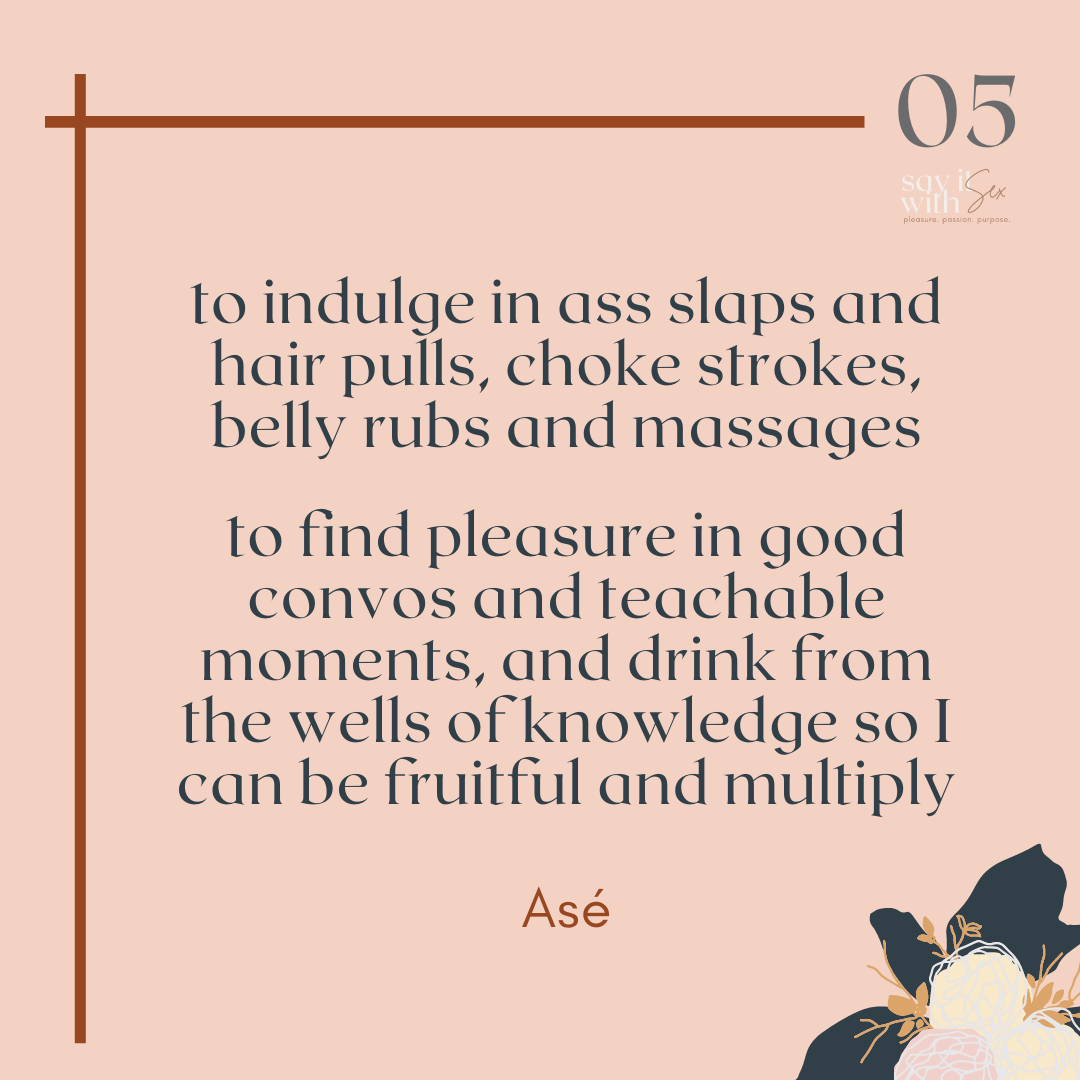
In our next exploration, we peel back the layers of seeing ourselves as the living altar.
Until we meet again.
